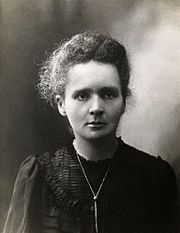
Marie Curie [Marie Skłodowska Curie]
“I believe that Science has great beauty. A scientist in his laboratory is not a mere technician; he is also a child confronting natural phenomena that impress him as though they were fairy tales.”
Marie Curie
Synopsis
Born Maria Sklodowska on November 7, 1867, in Warsaw, Poland, Marie Curie became the first woman to win a Nobel Prize and the only woman to win the award in two different fields (physics and chemistry). Curie’s efforts, with her husband Pierre Curie, led to the discovery of polonium and radium and, after Pierre’s death, the further development of X-rays. She died on July 4, 1934.
Science Celebrit
Marie Curie made history in 1903 when she became the first woman to receive the Nobel Prize in physics. She won the prestigious honor along with her husband and Henri Becquerel, for their work on radioactivity. With their Nobel Prize win, the Curies developed an international reputation for their scientific efforts, and they used their prize money to continue their research. They welcomed a second child, daughter Eve, the following year.
In 1906, Marie suffered a tremendous loss. Her husband Pierre was killed in Paris after he accidentally stepped in front of a horse-drawn wagon. Despite her tremendous grief, she took over his teaching post at the Sorbonne, becoming the institution’s first female professor.
Curie received another great honor in 1911, winning her second Nobel Prize, this time in chemistry. She was selected for her discovery of radium and polonium, and became the first scientist to win two Nobel Prizes. While she received the prize alone, she shared the honor jointly with her late husband in her acceptance lecture.
Around this time, Curie joined with other famous scientists, including Albert Einstein and Max Planck, to attend the first Solvay Congress in Physics. They gathered to discuss the many groundbreaking discoveries in their field. Curie experienced the downside of fame in 1911, when her relationship with her husband’s former student, Paul Langevin, became public. Curie was derided in the press for breaking up Langevin’s marriage. The press’ negativity towards Curie stemmed at least in part from rising xenophobia in France.
When World War I broke out in 1914, Curie devoted her time and resources to helping the cause. She championed the use of portable X-ray machines in the field, and these medical vehicles earned the nickname “Little Curies.” After the war, Curie used her celebrity to advance her research. She traveled to the United States twice— in 1921 and in 1929— to raise funds to buy radium and to establish a radium research institute in Warsaw.
All of her years of working with radioactive materials took a toll on Curie’s health. She was known to carry test tubes of radium around in the pocket of her lab coat. In 1934, Curie went to the Sancellemoz Sanatorium in Passy, France, to try to rest and regain her strength. She died there on July 4, 1934, of aplastic anemia, which can be caused by prolonged exposure to radiation
 people