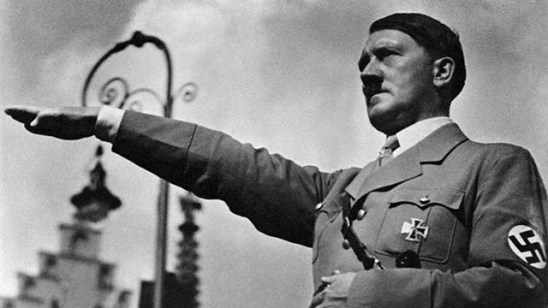
“Those who want to live, let them fight, and those who do not want to fight in this world of eternal struggle do not deserve to live.”
Adolf Hitler
Synopsis
Born in Austria in 1889, Adolf Hitler rose to power in German politics as leader of the National Socialist German Workers Party, also known as the Nazi Party. Hitler was chancellor of Germany from 1933 to 1945, serving as a dictator for the bulk of his time in power. His policies precipitated World War II and the genocide perpetrated against Jewish communities known as the Holocaust. With defeat on the horizon, Hitler committed suicide with wife Eva Braun on April 30, 1945, in his Berlin bunker.
Background of Hitler
In 1913, Hitler relocated to Munich. At the outbreak of World War I, he applied to serve in the German army. He was accepted in August 1914, though he was still an Austrian citizen. Although Hitler spent much of his time away from the front lines (with some reports that his recollections of his time on the field were generally exaggerated), he was present at a number of significant battles and was wounded at the Somme. He was decorated for bravery, receiving the Iron Cross First Class and the Black Wound Badge.
Hitler became embittered over the collapse of the war effort. The experience reinforced his passionate German patriotism, and he was shocked by Germany’s surrender in 1918. Like other German nationalists, he purportedly believed that the German army had been betrayed by civilian leaders and Marxists. He found the Treaty of Versailles degrading, particularly the demilitarization of the Rhineland and the stipulation that Germany accept responsibility for starting the war.
World War II & The Holocaust
In 1938, Hitler, along with several other European leaders, signed the Munich Agreement. The treaty ceded the Sudetenland districts to Germany, reversing part of the Versailles Treaty. As a result of the summit, Hitler was named Time magazine’s Man of the Year for 1938. This diplomatic win only whetted his appetite for a renewed German dominance.
The Nazis continued to segregate Jews from German society, banning them from public school, universities, theaters, sports events, and “Aryan” zones. Jewish doctors were also barred from treating “Aryan” patients. Jews were required to carry identity cards and, in the fall of 1938, Jewish people had to have their passports stamped with a “J.”
On November 9 and 10, 1938, a wave of violent anti-Jewish pogroms swept Germany, Austria and parts of the Sudetenland. Nazis destroyed synagogues, vandalized Jewish homes, schools and businesses and close to 100 Jews were murdered. Called Kristallnacht, the “Night of Crystal” or the “Night of Broken Glass,” referring to the broken glass left in the wake of the destruction, the pogroms escalated the Nazi persecution of Jews to another level of brutality and violence. Almost 30,000 Jewish men were arrested and sent to concentration camps, signaling more horrors to come.
On September 1, 1939, Germany invaded Poland. In response, Britain and France declared war on Germany two days later. Between 1939 and 1945, Nazis and their collaborators were responsible for the deaths of at least 12 million noncombatants, including about six million Jews, representing two-thirds of the Jewish population in Europe. As part of Hitler’s “Final Solution,” the genocide enacted by the regime would come to be known as the Holocaust.
Deaths and mass executions took place in concentration and extermination camps such as Auschwitz-Birkenau, Bergen-Belsen, Dachau and Treblinka, among many others. Other persecuted groups included Poles, communists, homosexuals, Jehovah’s Witnesses and trade unionists. Prisoners were used as forced laborers for SS construction projects, and in some instances they were forced to build and expand concentration camps. They were subject to starvation, torture and horrific brutalities, including having gruesome and painful medical experiments performed on them. Hitler probably never visited the concentration camps and did not speak publicly about the mass killings, but Germans documented the atrocities committed at the camps.
Hitler escalated his activities in 1940, invading Norway, Denmark, France, Luxembourg, the Netherlands and Belgium. By July, Hitler ordered bombing raids on the United Kingdom, with the goal of invasion. Germany’s formal alliance with Japan and Italy, known collectively as the Axis powers, was signed towards the end of September to deter the United States from supporting and protecting the British.
On June 22, 1941, Hitler violated a non-aggression pact with Joseph Stalin, sending a massive army of German troops into the Soviet Union. The invading force seized a huge area before the German advance was stopped outside Moscow in December 1941.
On December 7, Japan attacked Pearl Harbor in Hawaii. Hitler was now at war against the Allied powers, a coalition that included Britain, the world’s largest empire, led by Prime Minister Winston Churchill; the United States, the world’s greatest financial power, led by President Franklin D. Roosevelt; and the Soviet Union, which had the world’s largest army, commanded by Stalin.
Though initially hoping that he could play the Allies off of one another, Hitler’s military judgment became increasingly erratic. Germany’s military and economic position deteriorated along with Hitler’s health. Germany and the Axis powers could not sustain Hitler’s aggressive and expansive war. In late 1942, German forces failed to seize the Suez Canal leading to the loss of German control over North Africa. The German army also suffered defeats at the Battle of Stalingrad (1942-43), seen as a turning point in the war, and the Battle of Kursk (1943). On June 6, 1944, on what would come to be known as D-Day, the Western Allied armies landed in northern France. As a result of these significant setbacks, many German officers concluded that defeat was inevitable and that Hitler’s denial would result in the destruction of the country.
Hitler’s political programs had brought about a world war, leaving behind a devastated and impoverished Eastern and Central Europe, including Germany. His policies inflicted human suffering on an unprecedented scale and resulted in the death of tens of millions of people, including more than 20 million in the Soviet Union. Hitler’s defeat marked the end of Germany’s dominance in European history and the defeat of fascism. A new ideological global conflict, the Cold War, emerged in the aftermath of the devastating violence of World War II.
 people